
Services / Tree Removal
Tree Removal
When a tree is dead, dangerous or just in the wrong place, we take it down piece by piece, lower each section clear of your house, and haul it all away. Family-owned in Brooklyn Park since 1981.
- Certified Arborist on Staff
- Licensed & Insured
- 24-Hour Emergency Service
Does This Tree Need to Come Down?
A tree with a problem isn’t always a tree that has to go. These are the signs to look for. What matters most is whether the tree could hit something: your house, garage, fence, a power line or the kids’ swing set.
Dead or Hanging Limbs
Bare branches in summer, or a broken limb caught up in the crown. Dead wood can drop without warning.
Mushrooms at the Base
Fungus growing on the trunk or roots usually means rot inside, where you can’t see how much sound wood is left.
A New or Growing Lean
A tree that has always leaned is one thing. A lean that’s new, or soil cracking and lifting on the far side, is another.
Cracks and Split Trunks
Deep cracks, or a tight V where two big stems meet, are where trees most often split apart in a storm.
Dying From the Top Down
A thin, bare top with leaves only lower down is how a stressed tree often starts to fail. It’s the classic sign of an ash with emerald ash borer.
Hollows and Cavities
Holes in the trunk, bark falling off, or a hollow sound when it’s tapped all point to decay inside the tree.
Not sure? We’ll come take a look for free. If the tree can be saved, we’ll tell you.
Get a Free EstimateHow a Removal Goes
Most trees in the northwest metro stand next to a house, a garage or a fence, so we don’t just cut and let them fall. Here’s what happens from the first visit to a clean yard.
-
Free Estimate
We walk the yard with you, look at the tree and everything around it, and give you a clear price.
-
A Plan for Every Piece
Before the first cut, we work out where each section will go so it misses the roof, fences, lines and gardens.
-
Down in Sections
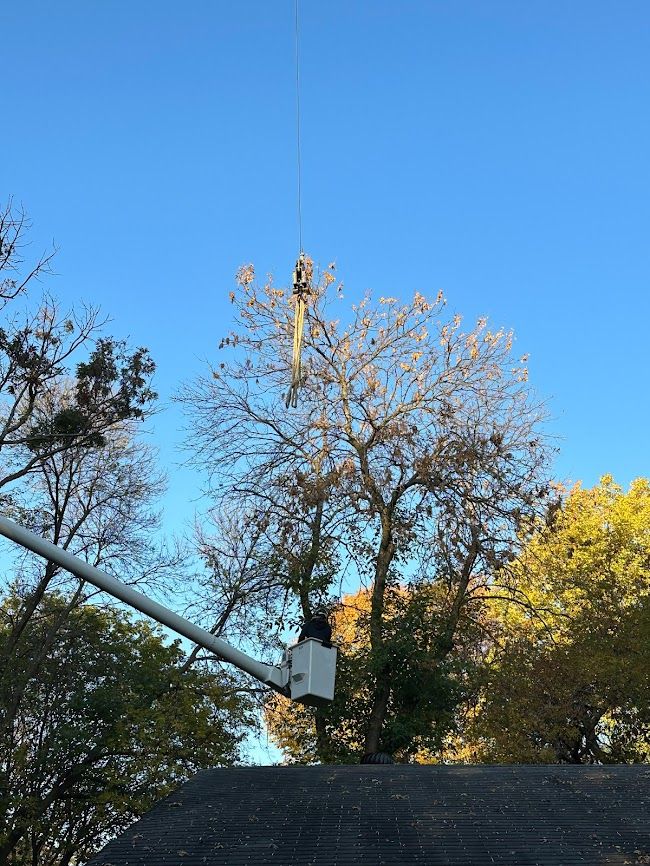
Limbs and trunk come down piece by piece, lowered on ropes or lifted out by crane when there’s no room to drop them.
-
Cleanup and Hauling
We load the wood with our clam truck, haul it away, and clean up the yard before we leave.
-
Stump Grinding
Want the stump gone too? We grind it down below the grass so you can reseed or plant again.
Nick’s crew was very efficient and took great care when working over the garage roof to ensure nothing hit the top of the garage.
Once the crane was setup, they started going to town. In 6 hours the tree was down and everything cleaned up.
Ash Trees and Emerald Ash Borer
About one in five trees in Brooklyn Park is an ash, and the emerald ash borer has been killing them across the northwest metro. If you have an ash, here’s how to tell where it stands.
- The crown thins out, dying from the top down.
- Woodpeckers flake off the outer bark, leaving light, blond patches.
- Bark splits open over S-shaped tunnels.
- Small D-shaped exit holes, about 1/8 inch across.
- New shoots sprouting from the trunk or base.
Treat It or Take It Down?
A large, healthy ash in a good spot can be saved with trunk injections every two years. Hennepin County puts the cost at about $200 to $300 per tree. Once an ash has lost much of its crown, or has died, removal is the safer choice: dead ash dries out and turns brittle, which makes it harder to take down safely the longer it waits.
Who’s Responsible?
In Brooklyn Park, ash trees on your property are yours to treat or remove. Boulevard trees, measured from the back of the curb, belong to the city, which treats or removes them at no cost to you.
The Wood Stays in the Metro
Hennepin, Ramsey and the other metro counties are under a state quarantine, so ash wood can’t be moved outside the area. When we take an ash down, we haul the wood away for you.
Help With the Cost
Brooklyn Park’s Remove and Releaf program pays to remove a dead ash and grind the stump for income-qualified homeowners (the 2026 lottery has closed). Hennepin County runs a similar program.
We had four ash trees removed that were infected with emerald ash borer. They showed up on time with a full crew and started right in.
When to Schedule a Removal
A dead or dangerous tree shouldn’t wait. For everything else, the calendar matters in Minnesota: two tree diseases and frozen ground all change the best time.
Ash TreesEmerald ash borer is inactive
OaksOak wilt risk
Your LawnFrozen ground carries the trucks
Oak Wilt
Fresh cuts on an oak from April through July attract the beetles that spread oak wilt. Red and pin oaks can die within weeks, and the disease travels to nearby oaks through their roots.
Emerald Ash Borer
Brooklyn Park recommends taking ash down between October and May, when the beetles aren’t flying, so they don’t spread from a cut tree to healthy ones.
Frozen Ground
In winter the ground is hard enough to carry heavy equipment without rutting the lawn, and bare branches show the whole tree. Stumps may have to wait for the thaw.
Sources: University of Minnesota Extension, Minnesota DNR, City of Brooklyn Park.
Stumps and What’s Underground
A grinder chews the stump and its main roots into chips below the grass, so the spot can be filled and reseeded or planted again.
Before anyone digs or grinds, Minnesota law requires the buried utility lines to be marked through Gopher State One Call (811). It’s free, and it takes about two business days.
The utilities only mark their own lines. Your sprinkler system, invisible dog fence, yard lights and lines to a shed aren’t on their maps, so let us know where they run.
Worked hard, cleaned up, removes stump, hauled away the chips and put down black dirt. All of this for a GREAT price.
Tree Removal Questions
Do I Need a Permit to Remove a Tree in My Yard?
Usually not for a tree on your own property, though rules vary by city. Trees on the boulevard, the strip between the curb and the sidewalk or your lawn, belong to the city. In Brooklyn Park the city takes care of those trees itself.
How Much Does Tree Removal Cost?
It depends on the tree’s size and condition, how close it is to the house or lines, whether a crane or bucket truck can reach it, and whether you want the stump ground too. That’s why every estimate is free and done in person.
Can You Take Down a Tree Right Next to My House?
Yes. We take it down in sections, lowering each piece on ropes or lifting it out by crane, so nothing lands on the roof, the garage or the fence.
What if the Tree Is Near Power Lines?
Stay well away from it and call your electric utility first. The lines are theirs to make safe, and once they have, we can take the tree down.
A Tree Just Fell. What Should I Do?
Keep everyone clear of the tree and any wires, then call us at (612) 987-6394. We offer 24-hour emergency service across the northwest metro.
Have a Tree That Needs to Come Down?
Estimates are free. Tell us about your tree and we’ll set up a time to come take a look.